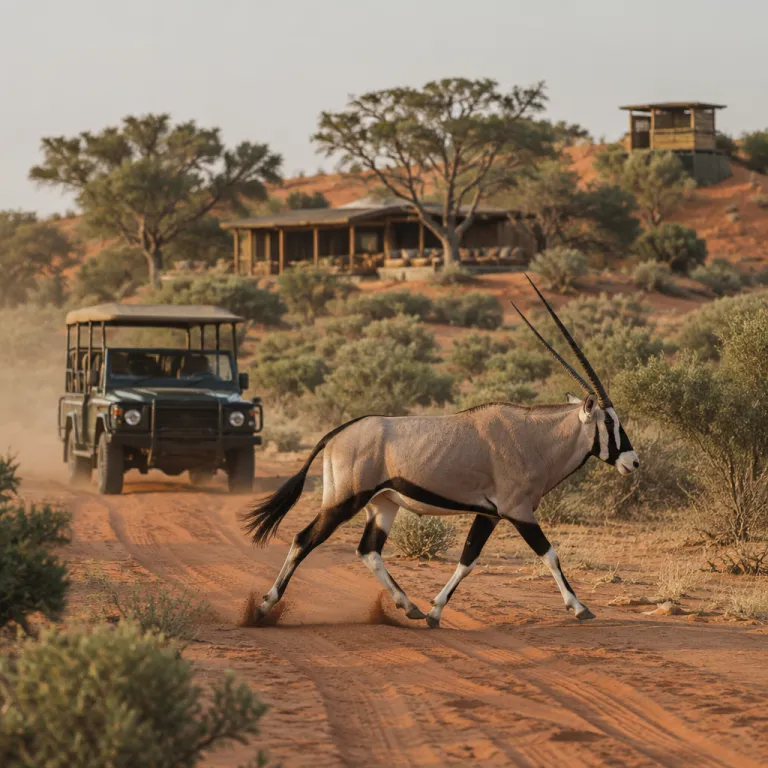
Tswalu Kalahari luxury safari reserve as South Africa’s private frontier
Tswalu Kalahari luxury safari reserve sits in the remote north of South Africa, where the red dunes of the southern Kalahari meet the granite folds of the Korannaberg mountains. This is not a typical African safari destination with a busy game reserve and a convoy of vehicles at every sighting, but a vast private reserve south of the Kalahari basin where space, silence, and time are the real luxuries. For South African guests used to Kruger or Madikwe, the first game drives across this kalahari reserve feel almost disorienting in their emptiness and scale.
The property known simply as Tswalu is family owned, and that single custodianship shapes every safari experience across its 114 000 hectares of restored kalahari game habitat. You are not entering a commercial park ; you are joining a long running conservation project that has turned degraded farmland into one of the best wildlife refuges in south africa. That is why the reserve limits guests to a fraction of what comparable safari lodges or safari camps would carry, keeping the game reserve feeling like a private safari frontier rather than a resort.
On a typical day, your safari vehicle may be the only one moving through an entire valley, with your guide tracker team reading the kalahari sand for signs of african wild predators and shy nocturnal specialists such as the aardvark. There are no other game drives crowding a sighting of a black maned Kalahari lion or a skittish cheetah, and no radio chatter pulling you away from a quiet moment with giraffe at a waterhole. That absence of traffic is what the reserve south of the Korannaberg mountains really sells ; not just luxury accommodation, but the rare feeling that the african safari landscape belongs to you alone, at least for a time.
What privacy really means at a private reserve in the Kalahari
Privacy at Tswalu Kalahari is not a marketing adjective, but a structural choice that shapes every safari experience. With only a handful of safari lodges and the low number of guests spread across the entire kalahari reserve, the density of people to land is among the lowest in any game reserve in Africa. That ratio is what allows the team to guarantee that your private safari sightings will never be shared with a queue of safari vehicle arrivals.
Each party is assigned its own guide tracker pairing and its own dedicated safari vehicle, so you set the rhythm of your game drives rather than following a lodge timetable. If you want to spend time with a coalition of black maned lions for hours, or track an aardvark burrow until sep twilight, there is no pressure to move on for the next group. This flexibility is especially valuable for South African travellers who have already sampled more structured african safari itineraries and now want something slower and more personal.
Back at camp, the privacy continues with generous spacing between suites and the option to dine alone under the african sky, rather than in a communal boma every night. The quiet is deep enough that you can hear the soft calls of african wild cats and the distant roar of kalahari game moving across the dunes. For those who crave digital disconnection, Tswalu belongs in the same conversation as other signal free stays in South Africa, and you can explore that broader trend through this curated look at South African lodges that turned disconnection into the room’s best amenity.
From game drives to walking with trackers: the depth of the safari experience
Many South African travellers arrive at Tswalu Kalahari expecting excellent game drives and polished service, but the real surprise is how varied the safari experience can be when a private reserve is not constrained by park rules. Classic morning and afternoon drives remain the backbone of any african safari here, with your guide tracker team using years of kalahari game knowledge to find everything from meerkat colonies to black maned lions. Yet the most memorable wildlife encounters often happen when you step away from the safari vehicle and slow down.
On foot, the Korannaberg mountains reveal a different face of the reserve south of the dunes, with ancient rock engravings and medicinal plants that San trackers interpret with quiet authority. Night drives focus on the elusive side of african wild life, when the aardvark, aardwolf, and bat eared foxes emerge, and when the sky over this part of south africa becomes a dense field of stars. Horseback safaris, sleepout decks, and photographic hides add further layers, turning a standard luxury safari into a multi dimensional immersion in kalahari ecology.
For travellers comparing options along the Garden Route or in the Eastern Cape, it is worth reading a refined guide to choosing a Garden Route safari lodge before deciding how Tswalu fits into a broader itinerary. The key distinction is that Tswalu Kalahari is not about ticking off the Big Five in record time, but about giving yourself the time and space to join the rhythms of a specific kalahari reserve. That is why repeat guests often return in different months, from the green flush of jan storms to the dry clarity of sep skies, to experience how the same game reserve shifts with the seasons.
Where you stay: safari lodges from Tswalu Loapi to Klein Jan
Accommodation at Tswalu Kalahari is deliberately varied, but every option is anchored in the same idea of low density luxury within a vast private reserve. The safari lodges range from the main Motse, with its thatched suites overlooking a waterhole, to the more exclusive Tswalu Loapi, a collection of tented safari camps designed for guests who want maximum seclusion. Each space is oriented towards the Korannaberg mountains or the open kalahari game plains, so the landscape is always the main event.
Tswalu Loapi in particular embodies the frontier spirit of this reserve south of the main lodge, with standalone homes that function almost like private safari villas. You have your own dedicated guide tracker team, your own safari vehicle, and the freedom to structure your days entirely around your interests, whether that is tracking black maned lions at first light or spending time with habituated meerkats. For South African families or groups of friends, this can feel less like a hotel stay and more like borrowing a piece of the kalahari for a few days.
Culinary experiences are equally considered, with the Klein Jan restaurant by chef Jan Hendrik van der Westhuizen bringing a level of gastronomic ambition rarely seen in a remote african safari setting. Here, the menu draws on ingredients from across south africa while remaining rooted in the kalahari reserve, with dishes that reference local game, foraged plants, and traditional preservation techniques. If you are planning a broader food focused journey, it pairs well with time in the Cape Winelands, and you can find inspiration in this piece on where to stay next in Stellenbosch wine country.
Conservation, research, and what your rate really funds
Rates at Tswalu Kalahari sit at the very top of the South African luxury safari market, and that pricing can feel daunting even for affluent local travellers. The crucial context is that this private reserve was conceived as a long term conservation project first, with tourism as the mechanism that funds habitat restoration and research. Every guest night contributes directly to the Tswalu Foundation, which supports scientists studying everything from aardvark behaviour to the dynamics of kalahari game populations.
Because the reserve south of the Korannaberg mountains is not constrained by the legacy of a state run game reserve, management decisions can prioritise ecological integrity over short term safari experience demands. That means allowing grasslands to rest, limiting the number of safari vehicle tracks in sensitive areas, and accepting that some african wild species will remain hard to see. For travellers who value authenticity over guaranteed sightings, this approach makes Tswalu one of the best examples of a modern african safari model.
The research presence also enriches the guest experience in subtle ways, from talks on black maned lion genetics to informal conversations with field biologists over dinner at Klein Jan. You may join a researcher for a morning tracking session, learning how they use data to understand wildlife movements across the kalahari reserve. In this sense, the luxury you are buying is not only privacy and comfort, but the chance to be part of a living, evolving experiment in how a private safari landscape in south africa can be managed for the long term.
How to book Tswalu as a South African traveller
For South Africans used to shopping around on hotel booking websites, Tswalu Kalahari requires a slightly different mindset. Availability is limited by design, with only a small number of guests accepted at any one time across all safari lodges and safari camps in the reserve. That scarcity means you should think in terms of seasons and experiences rather than chasing last minute deals or generic “best rate” promises.
The green season around jan brings dramatic skies, newborn wildlife, and a softer kalahari landscape, while the dry months leading into sep offer crisp mornings and excellent visibility for game drives. If you have already done a more traditional african safari in Kruger or the Sabi Sand, consider allocating more time here, even if it means trimming nights elsewhere. A minimum of four nights allows you to settle into the slower rhythm of a private safari, to join multiple activities beyond the vehicle, and to see how the light shifts across the Korannaberg mountains.
When comparing Tswalu Kalahari to other options in south africa, remember that the rate is fully inclusive of your dedicated guide tracker team, private safari vehicle, and a wide range of experiences that would be add ons at many game reserve properties. For families, the ability to tailor each day around different interests, from tracking african wild dogs to stargazing, often delivers better value than a shorter, more rushed itinerary. The real question is not whether Tswalu is the cheapest option, but whether this particular kalahari reserve offers the kind of deep, unhurried wildlife experience you want to remember years from now.
Who Tswalu is really for: beyond the first time African safari
Tswalu Kalahari tends to resonate most with travellers who have already fallen in love with africa and are now looking for something more singular than a standard game reserve circuit. If your first african safari was all about ticking off the Big Five, this private reserve south of the Korannaberg mountains invites you to care about aardvark, pangolin, and the subtle behaviours of kalahari game instead. It suits guests who value silence, space, and the freedom to shape their own time more than they value a packed social calendar.
For South African travellers, the appeal often lies in the contrast with more familiar bushveld landscapes closer to Johannesburg or Durban. The Kalahari’s red dunes, black maned lions, and vast skies feel almost like another country within south africa, yet the logistics are straightforward enough for a long weekend if you plan carefully. Couples, multi generational families, and small groups of friends all find that the combination of private safari flexibility and high touch service creates a rare sense of ease.
If you are the kind of person who prefers a quiet corner table at Klein Jan to a loud bar, who would rather join a researcher on a dawn walk than a crowded sundowner, and who cares where your money goes, then Tswalu is likely to feel like the best kind of indulgence. The reserve does not sell spectacle so much as intimacy with a specific african wild landscape, and that is a niche that no other safari lodges in the region quite occupy. In the end, what you are buying is not just a luxury safari, but a private frontier in time and space that is increasingly rare in africa.
Key figures that frame Tswalu Kalahari’s private frontier
- Tswalu Kalahari covers approximately 114 000 hectares of restored Kalahari habitat, making it one of the largest privately protected areas in South Africa (source : Tswalu official communications, area figure consistently cited across conservation reports).
- Guest numbers are capped at around 40 to 50 people across all lodges at any one time, which translates to more than 2 000 hectares of wilderness per guest (source : comparative analysis of lodge capacities published by South African tourism trade media).
- The reserve hosts over 80 mammal species and more than 240 bird species, including desert adapted black maned lions and cheetah, reflecting the biodiversity potential of rehabilitated farmland in the southern Kalahari (source : Tswalu conservation and species lists shared with researchers).
- Long term monitoring projects supported by the Tswalu Foundation have generated over 100 peer reviewed scientific papers on Kalahari ecology and species such as aardvark and pangolin, underlining the depth of research activity funded by tourism revenue (source : Tswalu Foundation publication summaries).
- Average stay lengths at high end South African safari properties cluster around three nights, while Tswalu reports a growing share of guests booking four to five nights, indicating a shift towards slower, more immersive safari experiences (source : South African luxury travel trade surveys and lodge booking data).
Frequently asked questions about Tswalu Kalahari luxury safari reserve
How does Tswalu Kalahari differ from Kruger and Sabi Sand safaris ?
Tswalu Kalahari is a private reserve in the southern Kalahari, not a bushveld park like Kruger or Sabi Sand. The landscape is defined by red dunes and the Korannaberg mountains, with desert adapted species such as black maned lions, aardvark, and pangolin. Guest density is far lower, so you will not share sightings with multiple vehicles, and activities extend well beyond standard game drives.
What is included in a stay at Tswalu for South African guests ?
A stay at Tswalu typically includes luxury accommodation, all meals, most drinks, and a dedicated guide tracker team with a private safari vehicle. Game drives, walking safaris, horseback rides, and many other activities are part of the rate, as is laundry and some in room amenities. Conservation levies that support the Tswalu Foundation’s research and habitat work are usually added as a separate line item.
When is the best time of year to visit Tswalu Kalahari ?
The green season around jan brings dramatic thunderstorms, lush grasses, and many newborn animals, creating beautiful photographic conditions. The dry months leading into sep offer cooler mornings, clear skies, and easier wildlife viewing as animals concentrate around water sources. South African travellers often choose based on whether they prefer dramatic skies and colour or crisp air and classic Kalahari tones.
How many nights should I book at Tswalu as a South African traveller ?
Three nights is the minimum many agents will suggest, but four to five nights allows you to experience the full range of activities without rushing. With more time, you can join multiple game drives, walks, and specialist experiences such as stargazing or time with researchers. Given the travel involved in reaching this remote reserve south of the Korannaberg mountains, a longer stay usually offers better value.
Is Tswalu suitable for families with children ?
Tswalu is well suited to families, especially when booking Tswalu Loapi or other exclusive use safari lodges where you have your own guide tracker team and vehicle. Activities can be tailored to different ages, from gentle game drives and dune walks to interactive conservation experiences. The privacy and flexibility of a private safari setup make it easier for parents to manage routines while still enjoying a high level of luxury.